Cheddar Man Had Dark Skin and Blue Eyes. A Consumer DNA Test Helped Prove It
Ten thousand years ago, Britain's oldest near-complete skeleton had dark skin, pale eyes and no ability to digest milk. Here is what his genome showed, and how a marker list from a recreational DNA test ended up at the centre of the investigation.
In 1903, workmen cutting a drainage trench in Gough's Cave in Cheddar Gorge, Somerset, hit a skeleton. They called him Cheddar Man, announced he might be 80,000 years old, and were wrong by a factor of eight.
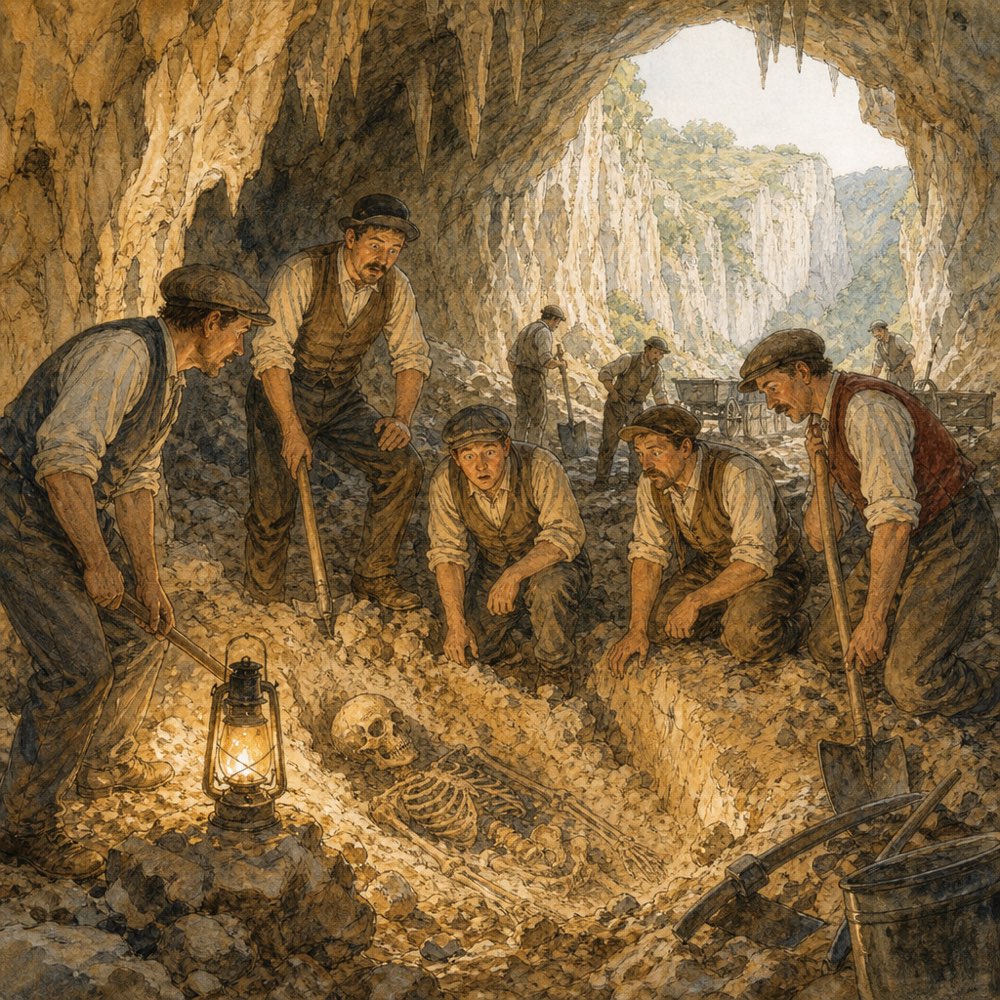 Gough's Cave, Somerset. Cool, stable, damp — near-perfect conditions for keeping DNA intact for ten millennia.
He was about 10,000 years old. He stood 166 centimetres. He died in his twenties. And for a century, nobody knew what he actually looked like.
The detail nobody expected
When the team at London's Natural History Museum finished sequencing his genome, the result cut against everyone's assumptions: Cheddar Man carried the variants associated with dark skin, pale eyes — blue or green — and dark, curly hair.
The prevailing view held that humans entering Europe 45,000 years ago adapted quickly to pale skin, which synthesises vitamin D more efficiently under weak sun. The timing doesn't hold.
"It seems that pale eyes entered Europe long before pale skin or blond hair, which didn't come along until after the arrival of farming," says Tom Booth, a researcher at the Natural History Museum. "Cheddar Man subverts people's expectations of what kinds of genetic traits go together."
Two variants sit at the centre of this. rs1426654 in SLC24A5, and rs16891982 in SLC45A2 — the two derived alleles most strongly associated with light skin in present-day Europeans. Cheddar Man carried neither. He did carry rs12913832, in the HERC2/OCA2 regulatory region, the allele behind blue eyes.
An analysis of 230 ancient Eurasians confirmed the pattern: light-skin alleles were under strong selection in Europe, but late — largely during and after the Neolithic transition (Mathieson et al., Nature, 2015).
The densest bone in the human body
Recovering 10,000-year-old DNA is still thankless work. "Ancient DNA doesn't necessarily mean that the specimen you're working with is thousands of years old," says Selina Brace, who specialises in ancient DNA at the Museum. "It just means that the DNA is degraded."
The team sampled the petrous bone — the inner ear bone, densest in the body, and the best natural vault for DNA. The cool, constant conditions of Gough's Cave did the rest.
Then comes the detail that makes this story unusual. Once millions of fragments were sequenced, someone still had to know where to look.
"I had taken a recreational DNA test that looked specifically at physical traits, and they had helpfully listed the markers they use to come up with their assessments," Booth says. That marker list, from a consumer test, went to the Museum's bioinformatics lab to help build the portrait.
The same class of markers that consumer genetics apps analyse was used to reconstruct the face of the oldest Briton we know.
What the reconstruction doesn't tell you
The bust made by Kennis & Kennis for Channel 4 travelled the world. It deserves a caveat.
"Facial reconstruction is part art and part science," Booth acknowledges. Predicting skin colour from ancient DNA is a probabilistic estimate with a confidence interval — not a photograph. The broad finding is solid and consistent with other European Mesolithic remains. The exact shade of the wax model is considerably less so.
Are you descended from him?
Almost certainly not, at least not directly. People in Britain today share roughly 10% of their genetic ancestry with the European population Cheddar Man belonged to.
The rest was largely replaced. Analysis of six Mesolithic and dozens of Neolithic British genomes shows Britain's farming transition was driven by incoming continental farmers, with little gene flow from local hunter-gatherers (Brace et al., Nature Ecology & Evolution, 2019, PMID: 30988490).
He was also, like every European of his era, lactose intolerant. The ability to digest milk into adulthood arrived much later.
Tracing your own Mesolithic thread
The Mesolithic Age DNA Test compares your genotype against hunter-gatherer populations from this period and estimates how much of your ancestry traces back to those groups. A higher-resolution version resolves more reference populations.
It won't tell you what colour your ancestors' eyes were. It will tell you what fraction of your genome still comes from the world Cheddar Man lived in — before the farmers arrived and redrew the map.
This post is an original summary. The underlying work is published in Nature Ecology & Evolution and Nature (linked above). Quotes from Tom Booth and Selina Brace come from the Natural History Museum's public Cheddar Man feature.