Around 2500 BC, Someone Arrived in Britain and Replaced 90% of Its Gene Pool
A study of 400 ancient genomes traced the Bell Beaker expansion across Europe and found that in Britain it coincided with the replacement of roughly 90% of the island's ancestry within a few centuries. What the DNA shows, and what it still cannot say.
Between roughly 2750 and 2500 BC, a distinctive style of pottery — bell-shaped, decorated in horizontal bands — spread across western and central Europe. Archaeologists have argued about the Bell Beaker complex for over a century. Was it people moving, or just a fashion moving?
The honest answer turned out to be: both, depending on where you look.
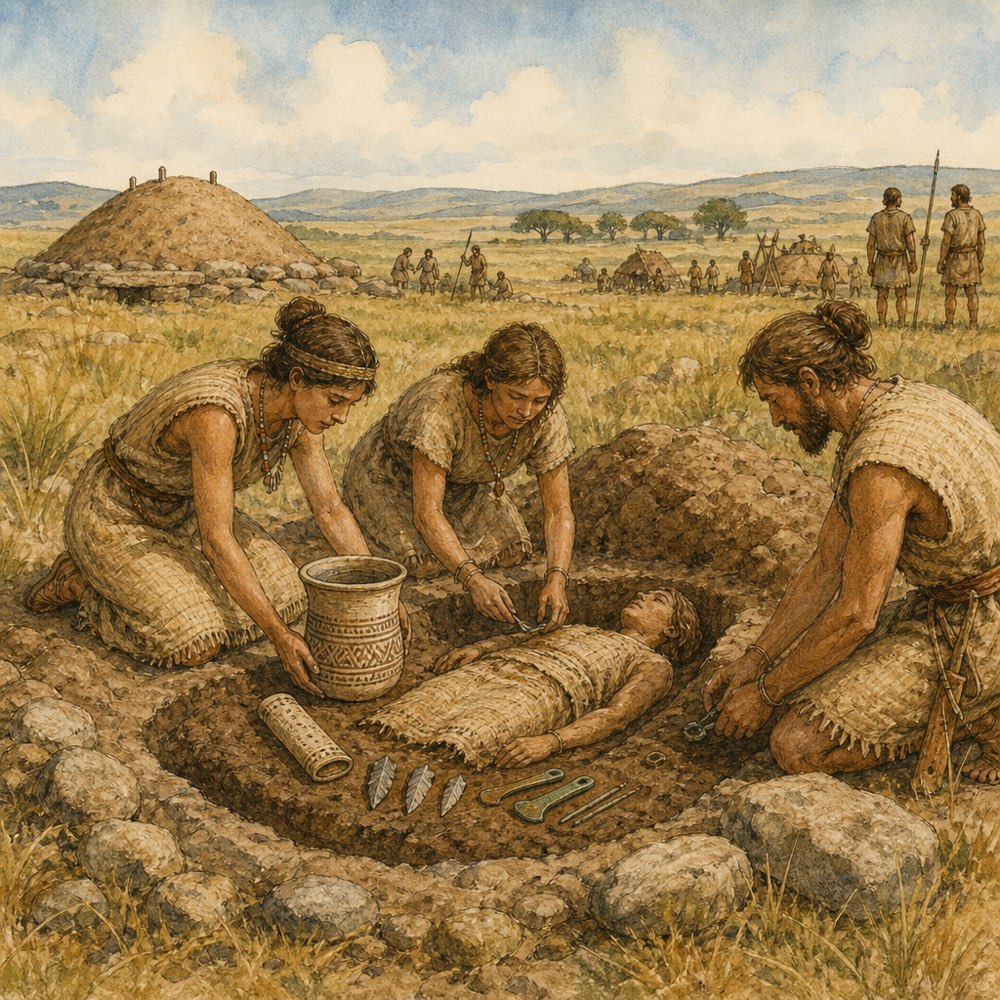 The Bell Beaker package: a distinctive vessel, archery equipment, copper tools. It travelled across Europe by two entirely different mechanisms.
400 genomes
A team sequenced genome-wide data from 400 Neolithic, Copper Age and Bronze Age Europeans, including 226 individuals buried with Beaker-complex artefacts (Olalde et al., Nature, 2018, PMID: 29466337).
Between Iberia and central Europe, they found only limited genetic affinity among Beaker-associated individuals. In that direction, the pottery spread without the people — cultural transmission, not migration.
Britain was a different story entirely. There, the arrival of the Beaker complex brought high levels of steppe-related ancestry and coincided with the replacement of approximately 90% of Britain's gene pool within a few hundred years.
The Neolithic farmers who built Stonehenge were, genetically speaking, almost entirely succeeded.
Where the steppe ancestry came from
That incoming ancestry traces back to the Pontic-Caspian steppe. An earlier study had documented a massive migration from that region into central Europe around 2500 BC, associated with the Corded Ware culture and carrying ancestry ultimately derived from Yamnaya pastoralists (Haak et al., Nature, 2015, PMID: 25731166).
The Britain result extends that east-to-west wave one island further, and the timing is tight enough that "a few hundred years" is doing a lot of quiet work in that sentence.
What "replacement" does and doesn't mean
It is a statement about ancestry proportions in a sample of sequenced skeletons. It is not, by itself, a description of what happened to anyone.
Ninety percent turnover is compatible with several histories: violence, disease, differential fertility, gradual absorption, or some combination running over ten or fifteen generations. Ancient DNA is very good at telling you that a population's ancestry changed. It is much weaker at telling you why.
Sample sizes for any single region and century remain small, and burial practices decide who ends up sequenced — cremation, for instance, erases people from the record entirely. The broad signal is robust and has replicated. The fine-grained story is still being argued about, as it should be.
Where these datasets live
Studies like these are aggregated into the Allen Ancient DNA Resource, the curated compendium of published ancient human genomes maintained by the Reich Lab (Mallick et al., Scientific Data, 2024). It is the reference panel that consumer ancient-ancestry tests compare your genotype against.
Reading your own Bronze Age ancestry
The Bronze Age DNA Test compares your genotype with ancient gene pools from this period and estimates your similarity to each; an advanced version resolves a larger set of reference populations.
One caveat worth carrying into any result: an admixture percentage is a similarity measure against a chosen set of reference populations. Change the reference panel and the percentages change. It tells you something real about your genome's relationship to sequenced ancient groups — not your nationality, and not who you are.